





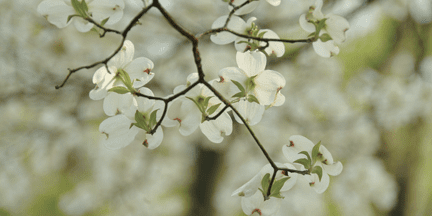
The dip in blossoms compared to 2014 and in contrast to some dogwoods in individual lawns around the area, prompted further investigation. Our research reveals that dogwoods seldom produce the same number of blooms each year. Forest dogwoods simply can not sustain a large annual production of seeds and blossoms. A healthy lawn tree that receives full sun and plenty of water, will more likely produce a more regular bloom cycle. Often, when there is a large display of blossoms in spring, there will be an abundant crop of berries that fall. The next year, a lighter bloom will result in a sparse berry crop. Like most spring-flowering plants, dogwoods form buds over the summer that will become next year’s blooms. By September, there is usually a collection of button-shaped flower buds that will help determine the flowering intensity of a specific dogwood tree the following spring.
Although a cold, wet winter can be blamed for difficulties experienced by many plants, dogwoods are rarely affected by cold. They are far more likely to be injured by drought because their roots are shallow.
Native woodland dogwoods seldom reach more than 15 feet tall as an understory tree. They are typically found very near to a larger tree and therefore are suppressed by competition for sunlight, moisture and nutrients. Most often, their location is determined by seed dropped by birds that have perched on a tree limb. Birds are attracted to the bright red seeds of dogwood. Isolated trees are more vulnerable to grazing, rutting and trampling by deer. That is why you will often see scores of short or broken dogwoods and relatively few tall specimens in the forest. Those that do survive will typically have a meandering trunk with all their limbs high above the reach of deer. This is in part because the plant is reaching for light and secondly because the lower limbs have either succumbed to grazing or simply starved for light during previous growing seasons.
When a dogwood succumbs to age or damage, it typically sends up a cluster of shoots. Typically most of these will be grazed by deer leaving only one or two with leaves to reach skyward. This is the trees method of surviving in the wild. If a lawn dogwood dies, you can give it a better chance by trimming away all but one or two healthy shoots when they are about a foot tall. This saves the root vigor for only those upright stems you want to groom as replacement for the tree you lost. If your dogwood becomes badly damaged by ice or wind, it’s best to cut it to the ground right away. This too saves vigor for new growth the following season. Typically, in our region, new growth that emerges before the end of August should have time to harden enough to the environment to survive winter. Later sprouts will usually suffer winter kill because they are too tender but don’t despair. Watch that you don’t mow down new sprouts the following Spring and save only the ones you intend to nurture into a new tree. Dogwoods like most native trees will try to replace themselves. This saves you digging not only a new hole but digging in your pocket for $20 to $75 dollars.
Fertilizing a dogwood is counterintuitive. While many gardeners may pump phosphorus to dogwoods in an attempt to prompt more blooms, it is easy to damage the tree’s fragile root system. More commonly, dogwoods need a boost of nitrogen to develop vigor. An ideal fertilizer should be either 12-4-8 or 16-4-8. Any application should be made lightly in April or May. It is best to control weeds and grass around a dogwood because of its shallow root zone. Dogwoods don’t grow well in soggy soil but because they are susceptible to drought, they do best if heavily mulched until established and prefer a pH level around 5.5.
It is always a good idea to have your soil tested to determine what your soil needs… or just as importantly, DOESN’T need. Text kits are available at no cost at your county extension office.
Dogwoods are appreciated not only for their spring blossoms but their fall color as well. In seasons of adequate rainfall, dogwood leaves linger until frost before turning bright orange and red along with their red berries. In drought years, the trees cut short their growing season by dropping their leaves as early as August to preserve root moisture. The roots of a dogwood continue to grow through winter except when the ground is frozen. In extreme drought, the entire tree may die above ground only to send new sprouts the following spring. Redbuds survive in similar fashion.
The semi annual dogwood walk hosted at Avalon Keep Botanical Gardens provides a short half mile circuit and a longer two mile route through groves of native dogwood, oak and wild huckleberry clusters.
About Author

Jeri Pearson
Jeri is the News Director for Pulse Multi-Media and Editor of The Polk County Pulse. She has 10 years of experience in community focused journalism and has won multiple press association awards.


More Stories
History Minute — Halloween
Polk County Fair Catalog-2025
Actors of all skill levels, beginners included, welcome to improv class