





Halloween approaches, creeping up on us at the end of this week. The holiday has become a celebration. Its history has been told ad nauseum. Tales of ghosts, monsters and madmen abound. It’s a pretty sure bet every region in the world has at least one myth or legend of a monster, spirit, or supernatural creatures wreaking havoc any time of the year.
Telling spooky stories is creepier around a campfire on All Hallow’s Eve in a wooded setting surrounded by a veil of darkness and the unseen creatures of the night milling about and making noise. Then there’s a dark room with the flickering flame of a candle or sulphureous glow from a flashlight illumining the being dishing out a scary tale.
Arkansas has its share of monsters: the bear-like Ozark Howler or the dragonesque Gowrow that inhabit the dark caverns of the Ozark Mountains. The Newport area has the White River Monster, our own version of Nessie. There are plenty of ghost towns and ghost stories haunting abandoned buildings, the disembodied glowing lights traveling the train tracks of Dover or Gurdon, or old settlements taken over by the forests and those lost souls wandering in the old homesteads, frightening unwary hunters or campers.
And, of course, there’s the famous Fouke Monster, our very own Bigfoot, stalking the swamps and the Red River tributary Boggy Creek outside of Fouke, not far from Texarkana.
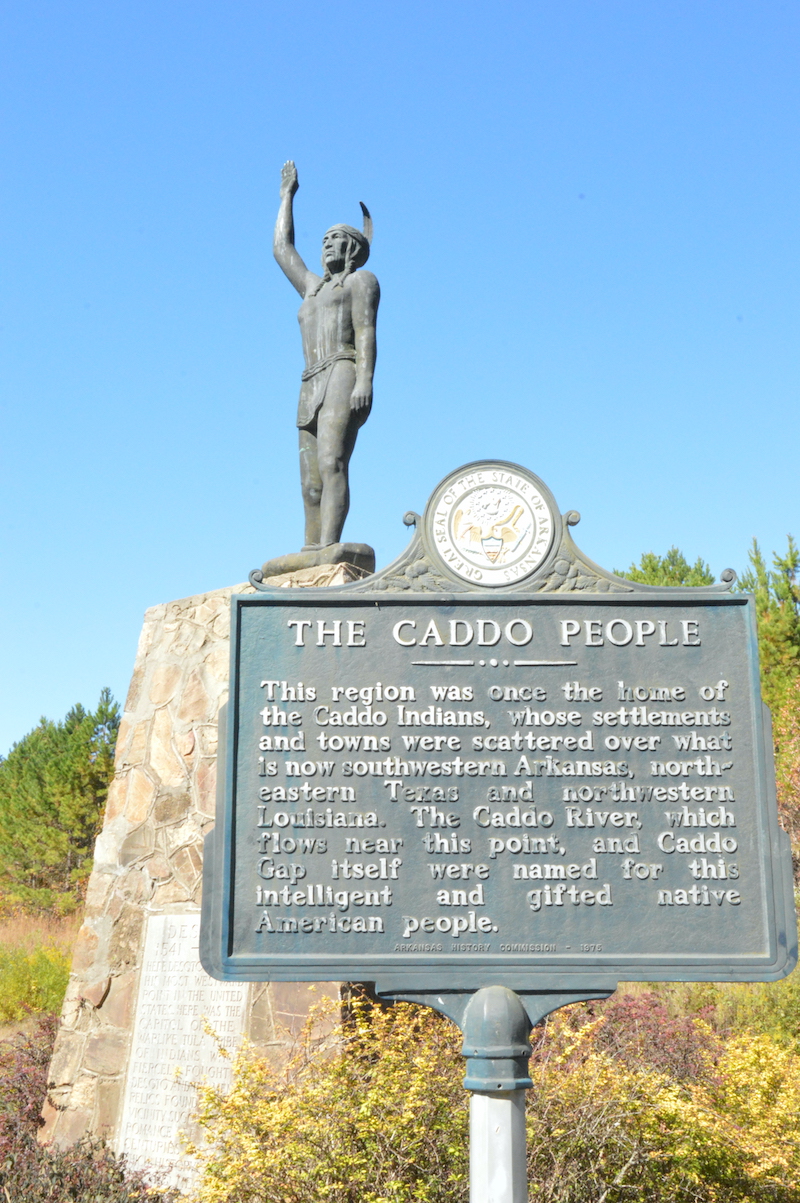
The Ouachitas have very few modern “ghost stories” it can call its own, so permit me to regale you with some American Indian mythology. Many folks may not recall some of the ancient Kadohadacho (Caddo) legends since the tribes were forced to relocate from the area in the mid-1800s. “Ouachita” is a name derived from the Caddo, specifically the Tula people. Known legends include the Underground Monster, defeated by lightning; the Daughter and the Serpent Monster, a deadly, giant snake with antlers; the malefic Lost Elves that live inside hollow trees, haunting the forests, abducting humans and turning them into elves.
Then, there is the legend of Caddaja, a gigantic, hideous, horned, man-eating ogre said to hate humans. Sometimes Caddaja, “Devil,” is described as resembling the horned, winged serpent Uktena of Cherokee legend. Caddaja figured in stories as being in opposition to Caddi-Ayo, the supreme being of the Caddo [Journal of American Folklore (Vol. 13, No. 48, Jan.-March 1900)]. The legend was reportedly told by a Franciscan friar in 1781 out of Texas who had interacted with the Tasinais (Texas) tribe, found in an unpublished Spanish manuscript entitled “Historia de Texas.” It’s probable the oral legend made its way northward, tribe to tribe, to the Tula.
A shortened version of the friar’s retelling of the Caddaja myth is very similar to the tale of the Daughter and Serpent Monster. Two sisters were out gathering food when, according to transcribed tales, “A devil!! A demon,” rushed out of the bushes and attacked. Its red eyes blazed like hot coals. It was adorned with horns so wide the tips stretched beyond view. The sisters ran, but the monster captured one sister, who happened to be pregnant. The beast snatched her up with its claws and shoved her into his mouth, gobbling her up.
The second sister managed to climb a tall tree standing along the shore of a large pond, with waters black and deep. The tree was so tall, Caddaja could not reach her. He tried to climb but fell. He clawed and gnawed at the roots with his enormous teeth, trying to fell the tree. He rammed the tree with his massive horns, shook it and attempted to snap it, repeatedly bending it back and forth.
Eventually, the tree began to weaken. The girl knew her time was short. She dove into the water to escape. Caddaja sucked up all the water, intending to scoop her up once it was drained, but she was nowhere to be found. The maiden knew of an underground stream, the source that fed the pond. She had tricked the monster, escaping up the stream until it surfaced far away in a sunny area.
Legend goes on to tell how. The girl and her mother returned to the tree once Caddaja had gone. They found the cap of an acorn with a single drop of blood in it. They returned home and the mother placed the bloodstained cap in a covered pottery jar. That night, they heard a scratching from the jar. They opened it to discover a little boy no bigger than the mother’s little finger. Startled, they covered the jar once more.
The next night, more scratching occurred. The jar burst open. Out stepped a handsome young man, the son of the deceased daughter. He was told the story of the attack, prompting Blood-Drop Boy to seek vengeance. His grandmother created a bow and arrow for him. The next morning Blood-Drop Boy tracked the ogre. He drew and fired, hitting Caddaja. The arrow sunk deeply into the beast, injuring, but not killing him.
Caddaja ran off, supposedly never seen again. Who’s to say Caddaja doesn’t still lurk amongst the rocky bluffs or the shadows deep within the thick Ouachita forests? Perhaps the demon traipses down to the Red River, seeking prey in eastern Texas or western Louisiana. A creature that large would cover quite a wide range to slake its thirst, hunting for its next human meal.
For more stories on the supernatural or true crime in Arkansas, listen to Trey Youngdahl’s podcast Unnatural Acts in the Natural State at TheOuachitaPodcasts.com/.


More Stories
Texas equine herpes outbreaks puts Arkansas, Texas, Oklahoma horse communities on alert
US Marines of Polk County commemorate 250th anniversary
The Ouachita Trading Post 2025 Halloween Coloring Contest