



BY MELANIE BUCK –
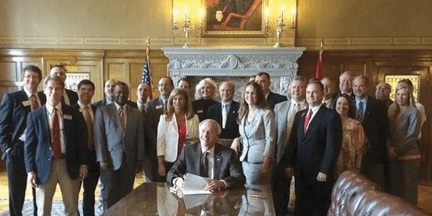
The General Assembly has passed and Governor Asa Hutchinson has signed into law the Arkansas Unpaved Roads Program Act 898, which could significantly improve the way that some unpaved roads are constructed and maintained in the state. Polk County Judge Brandon Ellison is a co-chair to the program and testified to the Arkansas Senate City County and Local Committee in the Senate and to the House Transportation Committee promoting passage of the bill, which became, officially, Act 898 on April 2, 2015.
The bill will provide better funding opportunities for counties to provide training for road maintenance and techniques that minimize negative impacts to water and air quality. The funding will also allow for demonstrations of new and innovative techniques of dirt and gravel road construction and maintenance to assist in training of road crews, particularly in the area of sedimentation issues.
Environmental groups, such as the Center for Biological Diversity, have been pressuring the U.S. Fish and Wildlife Service to create a way to prevent what they deem is a freshwater extinction crisis. A settlement was reached between the two groups in 2011 that moved the protection process forward on 757 species and plants that “contribute to one of the most biologically diverse regions of the United States.”
The program sites the problem of sedimentation to erosion on unpaved roads. Eroding unpaved roads can channel rainfall runoff, increasing erosion and sediment delivery to streams, rivers, and lakes. The sediment is said to have negative effects such as filling-in gravel streambeds causing the loss of in-stream habitats, freshwater sources become more expensive to treat for drinking water, and also contributes to loss of lake capacities.
Eroding unpaved roads are expensive to maintain, requiring continual grading to smooth the surface of the roadway. Erosion damaged roads can also cause excessive wear and tear on vehicles. High levels of road dust are also a significant issue of unpaved roads in rural areas. Counties with mostly rural areas are hard pressed to find the funding to fix all of the issues. It often comes down to how much traffic the road has daily compared to another.
To properly correct the issues at hand, Best Management Practices, or BMP’s, are being implemented to reduce erosion and sedimentation by providing better drainage to the road system, stabilizing erodible ditches and drainage outlets, and creating a more durable surface. BMP’s generally cost more at the beginning, but can greatly reduce long-term costs.
Leaders of the program have set forth what they deem is the solution and say their vision is “to establish a proactive, incentive-based unpaved roads management program that results in the utilization of best management practices on rural unpaved roads to minimize erosion, stretch county dollars farther, and maintain and improve the health of priority lakes and rivers.”
The Act states that unpaved roads in the state are the transportation backbone for rural communities and for many economic sectors in Arkansas, including timber, agriculture, ranching, and energy. Unpaved roads provide access to the public for hunting, fishing, boating, hiking, and other recreational and tourist activities and public access is vital to the economy, tourism, and public enjoyment of natural resources in the state. The erosion of unpaved roads can have negative effects on the state’s economy, tourism, and natural resources.
Judge Ellison said of Act 898, “It inoculates us from litigation from environmental groups and it also gives a rural county judge a little bit of road money to work on roads. It’s a good thing.”
Wolf Pen Gap has been one of the areas affected by clashing views of endangered species and unpaved roads causing sedimentation in a waterway. Environmentalists were concerned over the Arkansas fatmucket mussel, one of only two mussel species in the state, while all-terrain vehicle riders were concerned over the 42 miles of trails threatened with closure and county officials were concerned over the loss of $58.6 million in tourist dollars from the popular attraction. A decision was handed out in January, by the United States Forestry Service, that leaves 41.7 miles of trails in Wolf Pen Gap open, either seasonally or year-round, making it a compromise between the groups.
The Arkansas Unpaved Roads Program will combine the resources of public and private organizations and provide incentives for the maintenance of select low-volume, unpaved public roads maintained by counties in Arkansas for the purpose of maintaining and improving the health of the state’s economy and natural resources. The state will use a public-private partnership arrangement to assist counties in funding unpaved road projects and provide funding for demonstration, training, promotion, and use of BMP’s in construction and maintenance of rural unpaved roads adjacent to or near lakes, rivers, or streams.
Judge Ellison said, “Our team and partners have worked hard on this effort over the last two years. This program will bring dollars from private and corporate entities as well as from existing state and federal agencies that will help rural counties. Polk County has already benefitted via a demonstration project. The Arkansas Unpaved Roads Program will also help us and the state fend off environmental litigation over the sedimentation issue as it relates to the Endangered Species Act.”
Partners of the program include Arkansas Association of Conservation Districts, Arkansas Farm Bureau, Arkansas Forestry Association, Arkansas Forestry Commission, Arkansas Game and Fish Commission, Arkansas Highway and Transportation Department, Arkansas Natural Resources Commission, County Judges, Natural Resources Conservation Service, The Association of Arkansas Counties, The Nature Conservancy, University of Arkansas, and U.S. Fish and Wildlife Service, as well as many more.
“There are targeted areas that are the most environmentally offensive. We have to be proactive in stopping the sedimentation.” Judge Ellison explained that these projects will not only be proactive, but it also gives drivers a better roadway. “When someone comes along to try to sue us over the sediment issue, and tries to shut down someplace like Wolf Pen Gap, or wants to close more roads than are closed now, we can tell the federal judge, ‘look, we’re proactive on this issue with this program. We do these things, to stop this problem,’ then the judge is going to see and know that we are trying.”

About Author

Jeri Pearson
Jeri is the News Director for Pulse Multi-Media and Editor of The Polk County Pulse. She has 10 years of experience in community focused journalism and has won multiple press association awards.



So will Brandon Ellison stop spending time in Little Rock now and actually come back and work to get our roads fixed and in good shape? He also needs to get our roadside vegetation under control. For this area’s dependency on tourism he does a great job making our road ways look and feel like crap. THUMBS UP!